Harnessing AI for Smarter Supply Chains
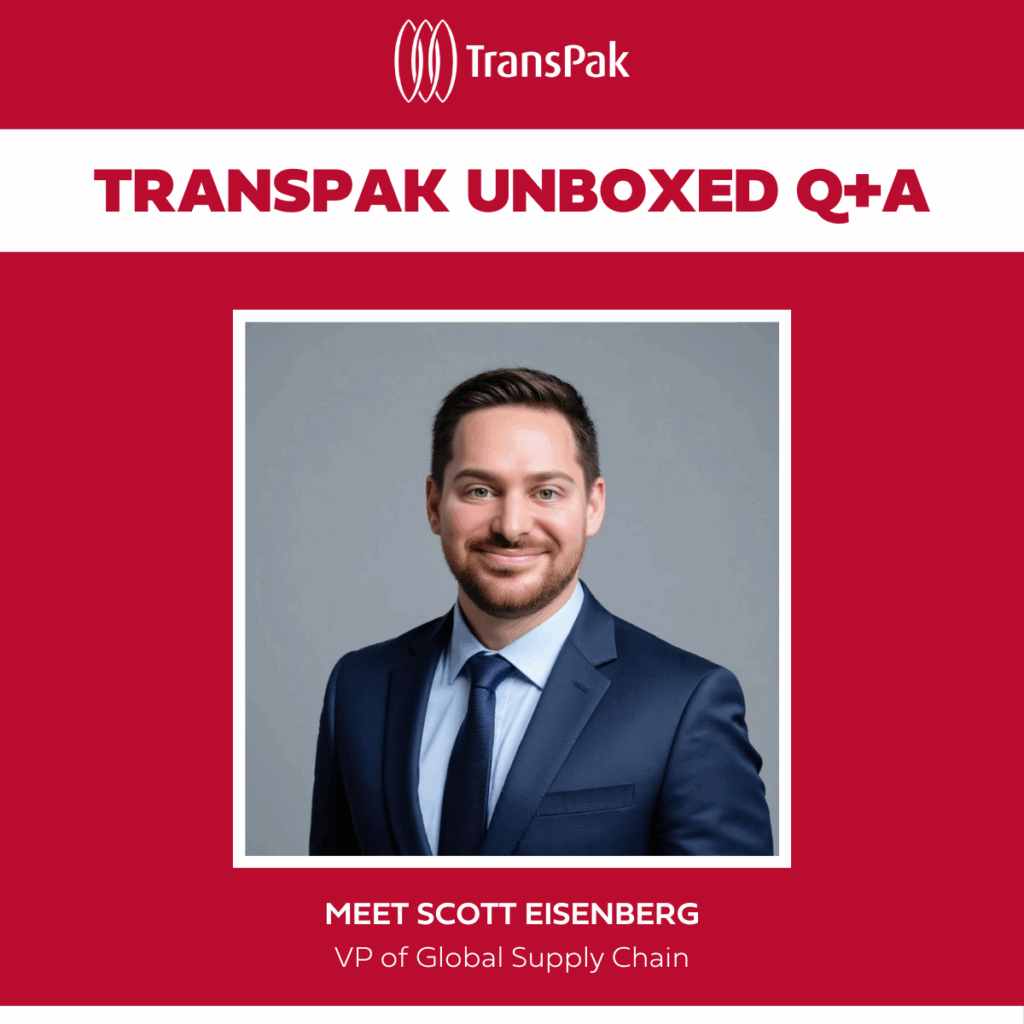
As AI quietly reshapes global logistics, leaders like Scott Eisenberg are helping guide that transformation from the inside out.
At the recent GDS Group’s Supply Chain Insight Summit, Scott joined peers from Caterpillar and Beyond Meat to explore how predictive AI is becoming the supply chain’s “crystal ball,” helping organizations anticipate disruptions and enhance forecasting.
In this edition of TransPak Unboxed, we go deeper with Scott to explore how TransPak is putting these ideas into practice. From invoice automation to AI-powered supplier negotiations, he shares how intelligent tools are helping simplify complexity, cut costs, and drive smarter supply chain outcomes.
Q: You started at TransPak as Head of Procurement—how did that lead to you spearheading the company’s AI efforts, and what kind of results have you seen?
Scott: When I joined the TransPak team as Head of Procurement, my scope soon expanded into Accounts Payable. One of the first things I did as a new member of the AP team was to help identify repetitive administrative tasks that had an opportunity for automation.
We found that the AP team was manually entering invoice data into our system and matching nearly 100,000 invoices to POs annually, and that if automated, these resources could be better utilized for more critical tasks. When there’s repetitive, non-value-added work, automation and AI tools can be a game-changer, and that’s what I find most exciting when exploring AI solutions.
The first AI tool we implemented for AP was X3CloudDocs. It learned our supplier invoice formatting, automatically pulled relevant data from the invoice, matched it to our POs, created exception reporting for review, and provided workflow approvals. So, instead of AP reviewing thousands of invoices a year, after implementing this AI solution, they’re only reviewing the five percent that have discrepancies. By removing 95% of the repetitive tasks they were doing, it freed our team up to focus on more critical activities.
Shortly after implementation, we achieved a record for on-time supplier payments, improved our payment turnaround times, and earned top-tier recognition from Dun & Bradstreet. It’s a great signal that we’re financially solid and a best-in-industry company for suppliers to work with.
Following the success of this implementation, we began exploring other opportunities to further leverage AI at TransPak.
Q: That’s a great internal example, but what about external? How is TransPak using AI to drive supply chain value for customers?
Scott: Negotiate AI is probably our most successful supply chain AI pilot so far. We started piloting it for our MRO category, which primarily includes equipment and shop consumables, and the results have exceeded expectations.
The AI solution is a self-service ordering tool that displays pre-negotiated pricing, market alternatives, and cost-saving options, includes AI-powered search, links to corporate accounts for compliance, and can even negotiate directly with suppliers.
The ROI for this tool was realized in the first month after implementation. This tool has been transformational to the global MRO team by effectively managing the high request volume of typically lower-value purchases.
After extensively testing it with MRO, our next step is to investigate a rollout to other product categories and lines of business, including our logistics function.
Leveraging this tool to gather quotes and market information and present it to the business award decision-maker will ensure that we obtain the best possible cost, quality, and service for our customers. This also speeds up our decision-making process, enabling us to improve lead times to our customers, a key value and differentiator when using TransPak.
But the biggest value isn’t just cost savings, it’s also time. It’s challenging to focus on strategic projects when you’re bogged down with administrative tasks. To me, the ultimate goal is this: our supply chain professionals are purely focused on critical, strategic projects, while AI tools quietly handle the supporting tasks in the background.
Most people don’t enjoy repetitive tasks anyway. Our brains are better used solving complex problems, not matching invoices or manually sending out individual quote requests. AI gives us that space to think and plan on a higher level.
Q: Are you starting to see TransPak’s AI tools interacting with other companies’ AI systems?
Scott: Yes, this has definitely started happening. Some suppliers are using AI to respond to our automated inquiries for things like confirming lead times. That’s where it gets really interesting: AI talking to AI. But our team is beyond careful. Rebecca Wise, TransPak’s VP of Technology Services, has developed a comprehensive AI policy, which includes a detailed review process.
Currently, every AI-generated output is reviewed by a human before being sent externally. At TransPak, we use AI for administrative lift, while keeping humans in the loop for judgment calls.
Q: Is TransPak using any other AI tools you haven’t mentioned yet?
Scott: Yes, we’re piloting tools that leverage RFID material tracking to detect internal bottlenecks and provide ordering optimization insights. We’re also piloting tools that leverage geofencing to automate our shipment tracking activities and monitor quality control KPIs.
The Legal team led by Nick Agate, is piloting DocJuris, an AI-guided contract creation and negotiation tool with built-in guardrails predefined by the TransPak Legal team. The Finance team, led by Liz Coles, is launching BlackLine, an AI-assisted tool that helps automate the month-end close process and account reconciliations.
We also formed an AI Steering Committee, which includes IT, ERP, Legal, Finance, and Ops. We evaluate tools cross-functionally to ensure we’re choosing scalable solutions, not just one-off fixes.
Q: If you had an unlimited budget, what are some AI systems you would implement?
Scott: Full ERP integration. Currently, many of these tools operate alongside our systems. The next level is embedding them directly into ERP, so when you create a PO, you instantly see insights on pricing, tariffs, lead times, and risks. It’s a heavy lift, but that’s the future—and we’re already building toward it.
Q: For other companies starting their AI journey in supply chain, what advice would you give?
Scott: Three things:
- Start small, but start now: You don’t need a massive data science team or perfect data to begin. Ask yourself: What portion of your data do you trust—or can you clean really quickly? That’s your entry point.
- Prove ROI quickly: Most vendors will offer a free pilot. Prove the value before you scale.
- Focus on security: Be very clear about what data is entered into each tool and who has access. That’s part of our internal policy.
If you start small and build momentum, your company will have five to ten AI tools up and running already before you know it. It’s not about a single breakthrough; it’s about starting small and safe and slowly building credibility and momentum.