
Using Field Data to Improve Packaging Performance, Protection, and Cost Efficiency
There’s a reason lab testing has been the backbone of industrial packaging qualification for decades. A controlled drop test, a calibrated vibration table, a compression load frame; these industry standards are precise, repeatable, and defensible. When a packaging design passes a rigorous lab protocol, that matters.
Your packaging passed the lab test. Now will it pass in the real world?
A lab test is a controlled approximation. A predefined drop height. A standardized vibration profile. A simulated temperature swing. Industry standard protocols were created with care and are genuinely useful. But they were also built with broadly based, generalized data. They may not account for a specific truck route through the Mojave Desert in August, a compounded vibration signature across a truck-to-ocean transfer, or an unusually rough forklift operator at a transfer hub in Atlanta.
Real shipping routes may require tailored shipping simulation. And that’s why TransPak has expanded its service to our customers: actionable field data and analytics to complement our extensive lab testing.
The Packaging Data Gap
Few things are as revealing to supply chain and packaging engineers as their first look at field data from actual shipping routes. For better or worse, the real world does not always match lab testing. Sometimes it can be more forgiving, sometimes drastically more punishing, and almost always in ways you don’t expect.
In some cases, packaging is over-engineered, meaning you’re paying too much for it. And sometimes the reverse is true; you’re under-protecting your product and don’t know it yet.
What Changes When You Instrument the Shipment
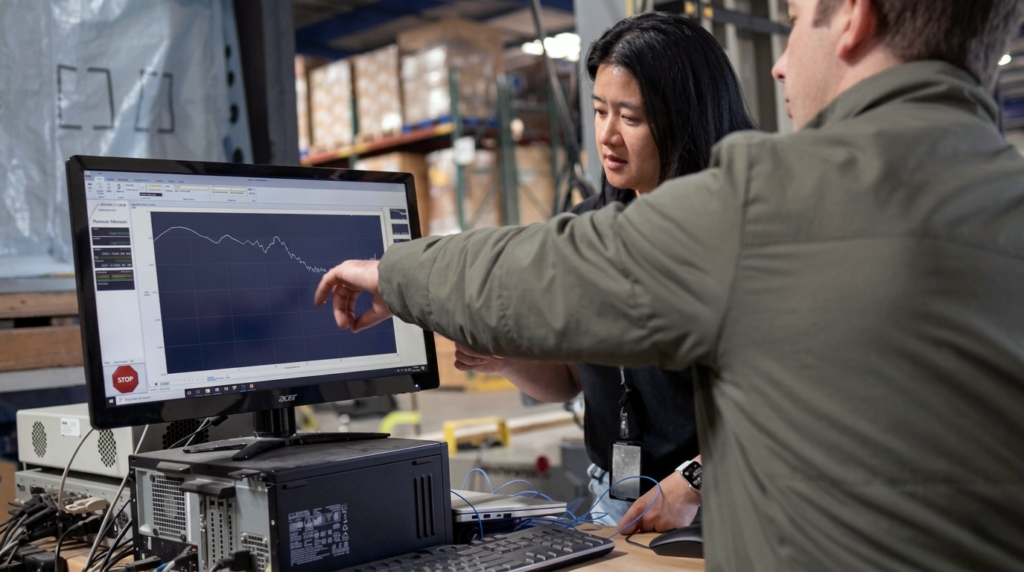
When you deploy high-fidelity environmental sensors on live shipments, and start capturing shock, vibration, temperature, humidity, and pressure across every leg of the journey, the guesswork disappears.
You stop asking “could that route be causing damage?” and start answering, “here is the exact shock event, the timestamp, the GPS coordinates, and the magnitude.”
You stop debating whether your lab test is rigorous enough and start knowing whether it reflects your actual distribution environment.
And critically, when something does go wrong, when a wafer fab tool arrives with a cracked casting or a server rack shows up with compromised components, you have timestamped, defensible evidence of what happened and where, not a speculation contest between your team, the carrier, and the customer.
Field Data Analytics: A Risk Management Tool
Field Data Analytics isn’t just a technical discipline. It’s a cost and risk management tool.
When field data shows your real-world drop events top out at 18 inches rather than the 30-inch lab simulation, you can right-size your foam density, reduce your crate wall thickness, and cut per-unit packaging costs, without sacrificing protection. When field data identifies a damage pattern concentrated at a specific intermodal transfer point, you can solve the actual problem in the supply chain instead of over-engineering the entire package.
And when you’re shipping a semiconductor tool worth $2 million, or a medical imaging system on a regulatory timeline, arrival-condition data isn’t a nice-to-have. It’s the documented proof that you did your job.
The Standard Is Changing
Leading companies across the semiconductor, hyperscaler, aerospace, and medical equipment industries need more than simple pass/fail test results. They want to establish confidence that the lab test reflects the real world, and they should. They also want documented evidence of safe delivery of their products with no compromise to integrated quality. If something goes wrong in transit, they want databased root cause analysis.
Field Data Analytics is how you provide that proof, and how you build packaging programs that are validated against reality. Field data and lab testing work together to build a more complete picture of packaging performance.
TransPak’s Field Data Analytics team, led by Vice President Eric Joneson, deploys environmental sensors on live shipments and translates the data into actionable packaging design and test recommendations. Learn more about our packaging performance testing services.