
How Multi-Material Design Delivers Smarter Protection
Believe it or not, for companies in the server rack, semiconductor, healthcare, and aerospace industries, their packaging is evolving just as quickly as their tech.
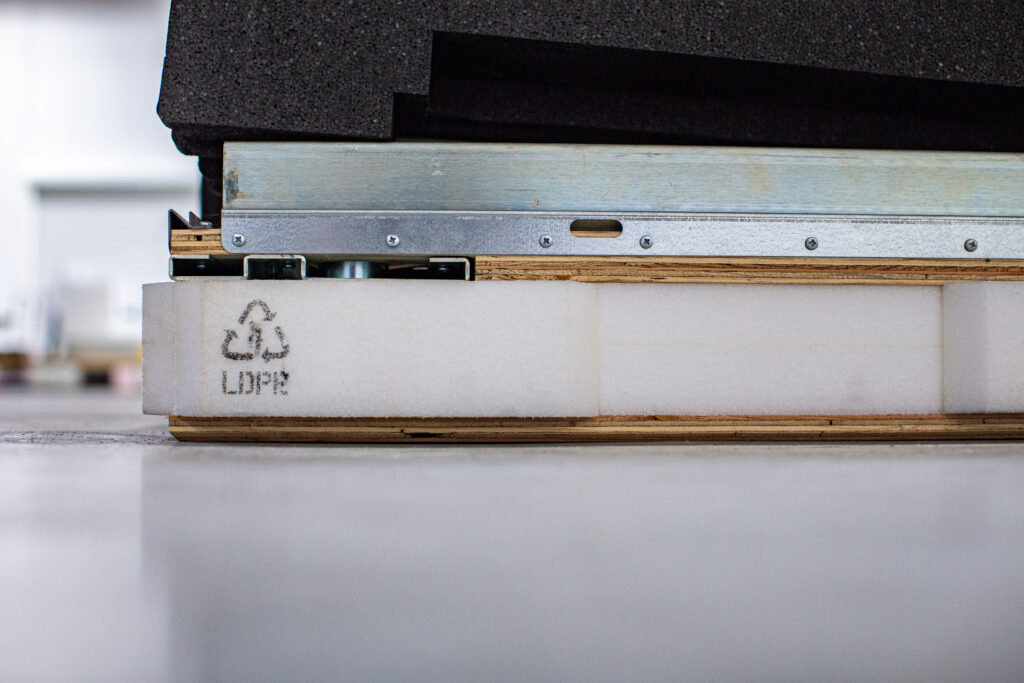
Across these high-tech sectors, customers are moving away from traditional all-wood crates for their valuable assets in favor of engineered, multi-material packaging solutions. These hybrid solutions combine corrugated, foam, thermoform, and other substrates into purpose-built systems that minimize material costs and carbon emissions while maintaining their protective power.
Major hyperscalers, for example, are increasingly adopting corrugated caps and hybrid structures in place of standard wood crates, driven in part by recyclability goals at the point of delivery. It is a meaningful change that is gaining momentum that – thanks to data-driven engineering and packaging testing – doesn’t sacrifice product protection.
Bigger Doesn’t Mean Better: Rethinking Protection with Hybrid Packaging
One of the most common questions from customers considering hybrid packaging centers on a simple concern: will it actually protect my product?
It’s an understandable concern. A heavy wood crate with thick foam lining looks protective and feels substantial. For years, that visual reassurance has shaped how companies evaluate their packaging, but appearance and performance are not the same thing.
A fully enclosed crate with dense foam does not necessarily mean superior protection. Similarly, a lighter multi-material packaging design that uses less raw material does not necessarily mean less protection. What matters is how the packaging is engineered relative to the product it carries: its weight, fragility profile, center of gravity, and the specific hazards it will face in transit.
Form, Fit, and Function
This is where the concept of form, fit, and function becomes critical. Every packaging system should be designed around the product it serves, not around an assumption of what protection should look like. The right combination of materials, precisely engineered and validated through testing, will outperform an overbuilt solution that was designed for optics rather than outcomes.
Case Study: From Traditional Crating to Hybrid and Multi-Material Packaging
A recent project for a leading semiconductor equipment manufacturer illustrates this point clearly. The customer had been shipping sensitive components in a traditional foam-lined wood crate. From the outside, the solution appeared maximally protective.
When our engineering team evaluated the solution using shock and vibration data, the picture changed. Even with substantial wood and dense foam, there was room for improvement in securing the product – vibration profiles and drop data showed that not all the forces the product encountered during transit were optimally managed.
TransPak’s engineers designed a hybrid, multi-material replacement that used a combination of corrugated, engineered cushioning, and structural reinforcements tailored to the product’s specific fragility and transit profile. The result was a solution that tested better across key performance metrics while also reducing material usage, overall weight, and cost. The redesign also simplified the pack-out process for the customer’s operations team.
None of those improvements came from guesswork. They came from engineering, instrumented testing, and data-driven iteration.
Engineering Packaging for Performance, Not Appearance
At TransPak, we are proud to take an engineering-first approach to protective packaging. Our goal is not to build the most impressive-looking solution; rather, it is to build the one that performs best for the product, the supply chain, and the customer’s bottom line.
Shock and Vibration Over Extra Material
In many cases, the most effective protective strategy is not adding more foam or a heavier exterior. Technical solutions like engineered shock absorption and vibration dampening systems are often far more effective than brute-force material. These approaches isolate the product from transit forces at a mechanical level, which a thick layer of static cushioning simply cannot replicate.
Minimizing Without Compromising
Our engineers optimize for the full picture: minimizing materials, reducing weight, lowering freight costs, and streamlining pack-out processes, all while meeting or exceeding the protection standards validated through ISTA and ASTM testing protocols. Every design decision is backed by data, and solutions are tested in our ISTA-certified lab before mass production.
The result is packaging that gives customers peace of mind – not because it looks heavy, but because the data proves it works.
Let’s Engineer a Better Packaging Solution
If your current packaging was designed around perception rather than performance, our engineering team can help. Visit transpak.com/design/ to start a conversation about what a data-driven, multi-material approach could look like for your high-value product.