
Bridging Design and Production: How Manufacturing Engineering Helps TransPak Scale Quality Globally
As TransPak continues to grow across regions, facilities, and industries, ensuring consistency across operations has become more important than ever.
That’s one of the key reasons the company recently established a dedicated Manufacturing Engineering function.
Manufacturing engineering has long been an important part of how TransPak delivers consistent, high-quality solutions for customers. As the company’s global footprint has expanded, TransPak established a dedicated Manufacturing Engineering function to further strengthen cross-site collaboration, standardize best practices, and help scale operational excellence across its worldwide network.
Manufacturing engineers help transform packaging designs into repeatable, scalable manufacturing processes, ensuring products can be built efficiently and consistently across TransPak’s global network.
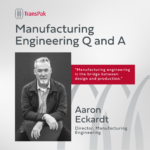
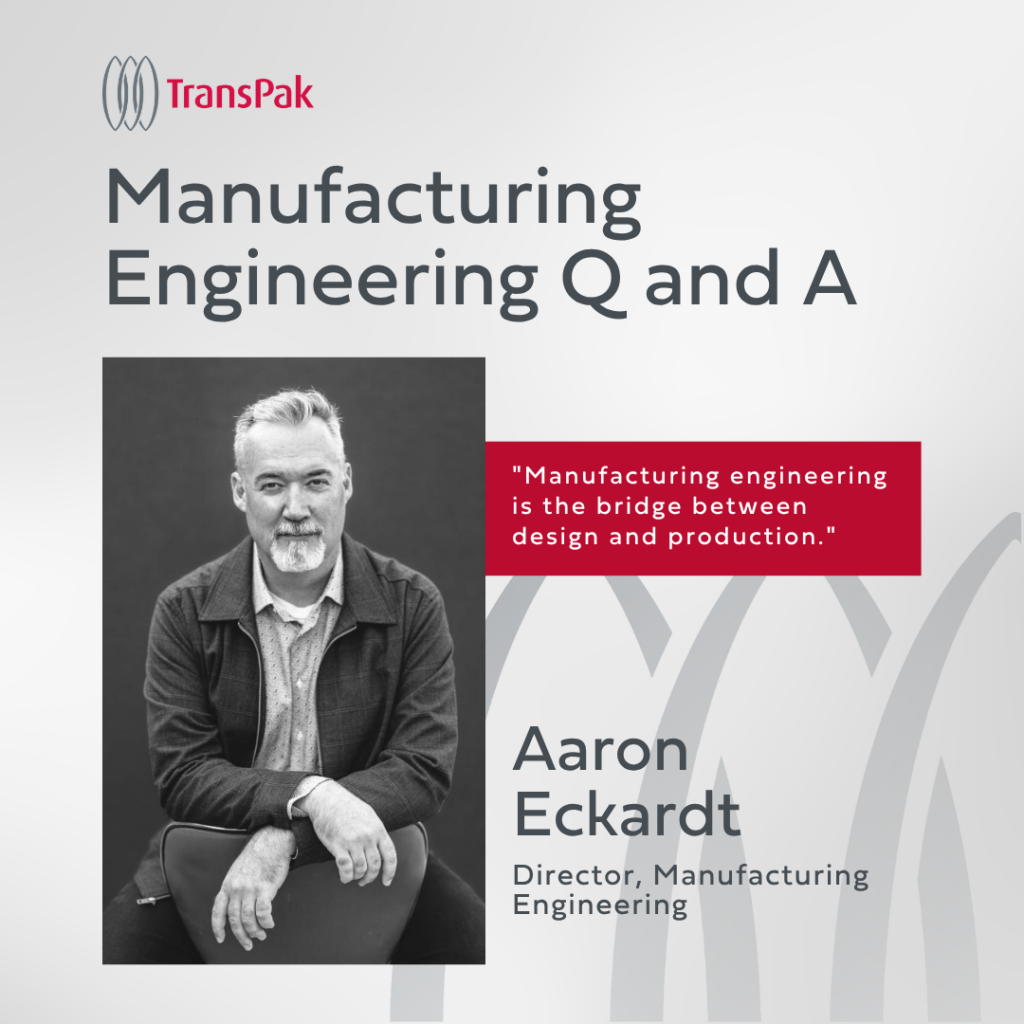
We sat down with Aaron Eckardt, Director of Manufacturing Engineering, to discuss the role of manufacturing engineering, how it supports customer outcomes, and why it’s becoming increasingly important as TransPak continues to grow.
Q: TransPak recently established a dedicated Manufacturing Engineering team. What is the purpose of your role, and what value does it bring to the organization?
Aaron Eckardt:
Manufacturing engineering is the bridge between design and production. As TransPak has grown in scale and complexity, that discipline deserves its own dedicated infrastructure. Engineers at the sites have always practiced it; now we’re giving it the structure, standards, and systems it deserves.
Design answers the questions; “What do we need to build? How do we solve the problem for the customer?” Manufacturing engineering answers the questions; “How do we build this with consistent accuracy and quality?” We achieve that by translating designs into the steps production needs to build it. A dedicated Manufacturing Engineering function means every site builds from the same standard, so consistency and quality are designed in, not validated after the fact.
My role is really about building the standards, capturing what works at each site, and creating the feedback infrastructure that keeps documentation current across our network. That’s how we maintain the foundation that every site builds from.
Q: How do manufacturing engineers help improve efficiency, consistency, and quality across operations?
Aaron Eckardt:
One of the biggest things manufacturing engineering does is create a feedback loop.
That feedback loop exists because manufacturing engineering owns the production system, the processes, standards, and work instructions that determine how a product gets built. At TransPak’s scale, over 50 manufacturing sites globally, that means building the shared infrastructure every site draws from: the process standards, the documentation discipline, the training. Operational decisions stay local. What Manufacturing Engineering provides is the foundation that makes those decisions easier to execute well.
A site might learn something about how they’re building a product, and they’ll fix it locally. But that information doesn’t always make it to other facilities. If the product moves or expands to another site in future builds, that information can’t be tribal knowledge. Manufacturing engineering builds the system so that solution travels with the product.
When we learn something on the production floor, we don’t just fix it at one site. We take those lessons and go back to the design phase and bake them in. It’s a continuous improvement process. You’re always asking, “How can we make this better?” Then, “How can we make it even better?”
What makes a global network genuinely powerful is that good ideas can come from anywhere in it. When a site develops a solution that cuts build time in half, manufacturing engineering is the function that captures it and makes it available everywhere. That’s how our scale becomes a source of innovation, not just a coordination challenge.
Manufacturing engineering is really about keeping that communication two-way, so we’re constantly sharpening the saw. When the process is right, production runs clean, delivery windows are met, and the customer gets consistent quality, every time.
Q: What does it take to move a packaging solution from concept to production?
Aaron Eckardt:
It starts with understanding the customers’ requirements, any regulations that need to be met, and how the product is ultimately going to be used. TransPak’s customers are often shipping high-value, complex assets; the stakes of getting it wrong are real. Translating a design from screen to floor is its own discipline, and that’s exactly what manufacturing engineering is built for.
The analogy I like to use is cooking. The designers create the recipe. They make the ingredient list, which is the bill of materials, and they’ve got the drawings, which show what the final product should look like. Manufacturing engineers come up with the cooking instructions and the list of tools you need to get there, that’s Design for Manufacturability in practice.
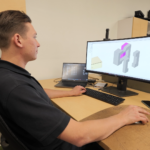
In the CAD world, everything fits together perfectly. Every hole lines up. Every component aligns exactly the way it’s supposed to. But once you get into production, you have to start asking different questions. What capabilities does the site have? What constraints do they operate under? How are operators actually going to build this product consistently?
Manufacturing engineering anticipates those questions before the job reaches the floor, so production isn’t discovering them mid-build. We take a design that works on paper and make sure it works consistently in the real world. That’s what keeps quality in the build, drives costs down and keeps delivery on schedule.
Q: Once a design is ready for production, what steps do you take to ensure it can be manufactured consistently and at scale?
Aaron Eckardt:
One of the most important steps is what we call the first article build. That’s the first time the product is actually manufactured.
Think of it as a dry run. You bring together quality experts, manufacturing leads, subject matter experts, and engineering teams to build what becomes the “golden sample.”
Manufacturing engineering structures that build so the learning is intentional, not incidental. Here, manufacturing engineering is about mistake-proofing the process.
The transition from a one-off build to scaled production is where manufacturing engineering earns its place. When a product gets built once, craftsmanship carries it, the operator knows the job and their experience is the process. When that same product needs to be built hundreds of times across multiple operators, craftsmanship alone isn’t a system.
I was once visiting a site where an operator was drilling a hole through hundreds of foam components. He had a template, a Sharpie, and was manually lining everything up each time before drilling the hole.
A manufacturing engineer looks at that process and asks, “How do we mistake-proof this?” Maybe we build a fixture so the foam can only fit one way. Now the operator doesn’t have to eyeball anything. They place the part, drill the hole, and every single time it’s correct. That’s really what we’re trying to do: mistake-proof the process and ensure the design intent is built in from the start, not verified after the fact. When the process is right, production runs clean, and the customer gets consistent quality on time, every time.
Q: How do Manufacturing Engineering and Packaging Engineering work together to ensure successful customer outcomes?
Aaron Eckardt:
My background is in industrial design, and that shapes how I think about this. Every person who touches a job is a user of the process we create. That includes the operator building it, the engineer releasing it, the purchasing sourcing it, and logistics shipping it. If we design that process well, it serves all of them.
Packaging engineering and manufacturing engineering are highly collaborative. The packaging engineer is focused on solving the customer’s problem. They’re determining how the product should be protected and what requirements need to be met.
Manufacturing engineering is involved from the start, making sure the solution is designed to be built efficiently and consistently, not adapted after the fact.
Sometimes a package is originally designed as a one-off custom solution. Maybe it’s only intended to be built once. But then later the customer orders a thousand of them. Building at a large scale means answering a different set of questions. Manufacturing engineering is already asking those questions, so when scale comes, the process is ready. The customer shouldn’t feel that transition. From their side, it should just work, same quality, on time, whether it’s unit one or unit one thousand.
A manufacturing engineer can take that design and translate it into a scalable production process, but we’re still working closely with the packaging engineers. If changes are being considered, we need to understand whether they affect the original design intent or any customer requirements.
One analogy I like is that of a writer and an editor. The writer creates the story. The editor helps refine it and get it ready for publication. Neither replaces the other. Together, they create a stronger final product.
And really, that’s another example of manufacturing engineering acting as a bridge function.
Q: What manufacturing trends, technologies, or innovations are you most excited about, and how do you see them shaping the future of TransPak’s operations?
Aaron Eckardt:
Sustainability is something that’s been important throughout my career, and it’s only going to matter more. Customers increasingly want solutions that reduce environmental impact, and they need those solutions at a price point that works.
The organizations that deliver on both will be the ones building process discipline now, in materials standardization, waste reduction, build efficiency. That’s exactly the kind of work manufacturing engineering is built to do.
I’m also excited by how quickly the world is changing. Supply chains are shifting, trade patterns are evolving, customer timelines are compressing, and AI is expanding what we can deliver and how quickly. The leaders who navigate that best will be the ones who ask not just how the process works, but how the people who depend on it actually experience it, operators, engineers, purchasing, logistics, customers.
I also believe design thinking touches every part of a business, and manufacturing engineering sits at the intersection of most of it. When we think holistically about how a solution moves from order to delivery, we find opportunities to improve both the value delivered to the customer and the cost of execution. That’s what makes this discipline so interesting to me.
One thing I’ve learned is that creativity really happens when you have constraints. If you have a blank page with no rules, it’s actually harder to create something meaningful. But when you’re working within constraints, that’s where innovation happens.
The pace of change rewards organizations that have their process infrastructure in place. And I think we’re going to have a lot of opportunities to get creative in our industry.
Looking Ahead
As TransPak continues expanding its global footprint, Manufacturing Engineering will play an increasingly important role in connecting design, production, and continuous improvement efforts across the organization.
By creating stronger feedback loops, standardizing best practices, and helping facilities learn from one another, the team is building a foundation for greater consistency, scalability, and operational excellence.
Or, as Aaron puts it, manufacturing engineering is about making sure valuable lessons don’t stay in one place. It’s about building systems that allow knowledge to move as efficiently as products do, so every customer benefits from what TransPak learns, no matter where in the world that product is built.
Learn more about how TransPak’s engineering teams help customers design, manufacture, test, and deliver packaging solutions that perform consistently around the world.