
How Engineered Packaging and Global Medical Device Logistics Ensure Safe Delivery of Critical Medical Technology
A surgical robot is only as good as its ability to arrive at the OR intact and ready for surgery. The same is true for every piece of high-value healthcare equipment leaving the manufacturing floor today. Yet for many companies, medical device packaging and medical device logistics remain an afterthought.
TransPak treats packaging and logistics as part of the product system. Medical device logistics, transportation, and protective packaging must work together to ensure devices arrive safely and ready for use.
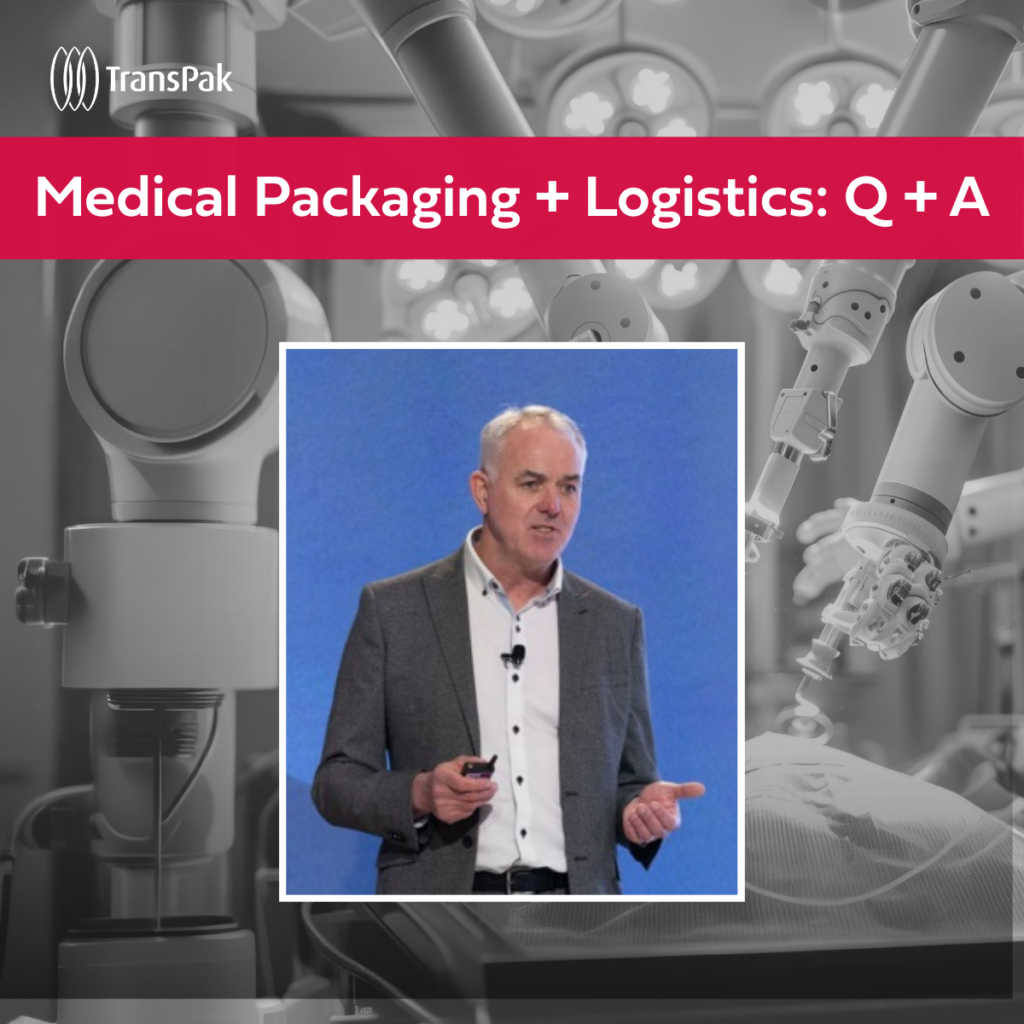
We sat down with Kevin Dempsey, Senior Director of Business Development, and Kevin Damian, Project Manager, to discuss how TransPak is supporting the healthcare industry. Here’s what they had to say.
Q: What types of medical equipment does TransPak support?
Kevin Dempsey:
We focus on high-value, complex medical and life science systems. That includes technologies like:
- Surgical robotics
- Mobile cart-based medical systems
- CT scanners and diagnostic imaging equipment
- Laboratory and life science instruments
- Advanced healthcare equipment used in hospitals and research facilities
Any system that is high-value, complex, and sensitive is something we’re well-positioned to support.
Q: Why should packaging and logistics be considered part of the product system, rather than a downstream task?
Kevin Dempsey:
At the end of the day, medical devices are all about the patient. You can have a fantastic machine sitting in a factory or on a design computer, but it’s no good unless it arrives at the clinic in full working order. It can only get to the patient if it’s delivered safely.
We work with product designers to understand the sensitivities of the instrument: the form factor, shape, and weight. Then we design optimal medical device packaging solutions to get it where it needs to be.
Kevin Damian:
Too often, if packaging isn’t thought about early in the process, it makes things much more challenging for both sides. You can design a fantastic product and bring it to life on the manufacturing floor, but if packaging is not considered during the design phase, there can be challenges that the design engineers never anticipated to get the product out the door. Bringing TransPak in early gives both sides the best opportunity to develop a quality, manufacturable, functional, cost-effective solution.
Q: What are the most common risks healthcare equipment faces during transport, and how does engineered packaging mitigate them?
Kevin Damian:
The biggest risk is damage, whether it’s physically visible or hidden within the instrument.
Material selection is critical. From crating and corrugate to foam solutions, the packaging must protect the product from shock, vibration, moisture, humidity, and salt air if we’re going trans-ocean. This is especially important when shipping medical equipment internationally, where environmental conditions and transit time can vary significantly.
Kevin Dempsey:
One thing people don’t always think about is resonance frequency. There are certain vibrations that will amplify and cause damage to specific components inside a medical device.
We can actually measure that and design our packaging to offset it. TransPak has one of the largest and most sophisticated packaging test labs in the US, where we validate solutions using ISTA-certified testing protocols. The packaging is highly customized, engineered, and specific to each device.
Q: Surgical robotics is one of the fastest-growing areas in healthcare. What makes this equipment particularly complex to package and ship?
Kevin Dempsey:
Surgical robots have very sensitive appendages or patient-facing components. Shipping something like a refrigerator is less complex because it’s contained in a cube. But a surgical robot has exposed, delicate components that extend beyond a simple box shape.
Our job is to understand where we can touch the device, which areas are sensitive, and what needs protection. We then design a solution that protects all of them. Our global engineering team is never going to give a customer an off-the-shelf solution.
Kevin Damian:
There’s another layer most people don’t think about; surgical robotics companies also operate demo fleets. Their sales teams move systems from hospital to hospital, which requires completely different packaging. Unlike equipment shipped once for installation, these units must be packed and unpacked repeatedly, requiring durable, reusable packaging designed for ongoing transport.
We’ve also seen companies that do not have crate packaging as a core competency. They’re experts at building and testing the instrument, but they need support when it comes to getting it packed correctly, shipped safely, and unboxed at the customer’s site. That’s where our white glove service comes in — our people on-site, providing training and guidance as needed, and making sure the product is packed correctly.
Q: How does TransPak’s global footprint support healthcare customers as they scale?
Kevin Dempsey:
A lot of medical device development happens in the U.S., but actual production often moves globally, perhaps in Southeast Asia or Eastern Europe. Here at TransPak, we have the geographic footprint, the engineering teams, and the global quality management systems to follow our customers wherever they go. Scale is not an issue for us.
Kevin Damian:
We’re positioned to support R&D development globally with a significant number of packaging engineers on multiple continents. Post design and development, wherever the product moves for manufacturing, we likely have a site nearby. When a project transitions from design to manufacturing, our local project managers are already communicating and transferring knowledge with project managers in that specific manufacturing region. There’s a seamless handoff, so the customer never loses continuity of their packaging solution.
Key Takeaways
- Start early. Packaging and logistics planning should begin at the design phase, not after manufacturing. Early collaboration leads to better, more cost-effective medical device packaging solutions.
- Custom is non-negotiable. Medical devices require purpose-built packaging that accounts for fragile components, resonance frequency, and real-world shipping conditions.
- We go where you go. TransPak’s global footprint means we can support your R&D in California, your pilot runs in Massachusetts and your production in Southeast Asia with consistent quality every step of the way.
- White glove from start to finish. From crating to delivery to on-site support, TransPak handles the entire journey so your team can focus on what they do best: building the technology that helps patients.
Talk to the experts. Reach out to our team about your medical device packaging and logistics needs: Healthcare Packaging & Logistics by TransPak.