
Closing the gap between packaging design and freight execution
In global shipping, cost and risk rarely come down to one decision; they come down to coordination. Even the best-engineered packaging can become expensive to move if transit realities aren’t considered early, and even the best logistics plan can get boxed in if packaging is designed without mode of transportation, space, and handling constraints in mind.
This isn’t an “engineering problem” or a “logistics problem.” It’s an industry-wide collaboration gap. It’s complex, and it’s exactly the kind of challenge TransPak is built to handle.
That’s why engineering for logistics is gaining momentum: designing protective packaging systems with transit in mind from the start, so shipments are both safe and efficient.
The industry challenge: two teams, two goals, one shipment
In many organizations, engineering and logistics sit in different departments with different priorities and KPIs. Engineering teams are focused on protection and compliance. Logistics teams are focused on cost, timing, routing, and mode selection. Both teams are doing the right things—it’s just not always coordinated early enough.
When freight isn’t part of the packaging design conversation upfront, companies can end up with a crate that’s highly protective, but expensive or awkward to transport.
Why freight cost gets underestimated
A key reason this gap shows up so often is that transportation pricing is complex.
Many shipments, especially in air freight, are priced not only on how heavy they are, but on how much space they occupy. Carriers commonly evaluate both actual weight and dimensional weight, which reflects the volume a package takes up. As a result, small changes in crate height or overall dimensions can trigger a higher pricing tier, reduce available routing options, or require special handling.
It’s often the height and volume of a crate that drives unnecessary freight cost.
Designing for multiple modes of transit
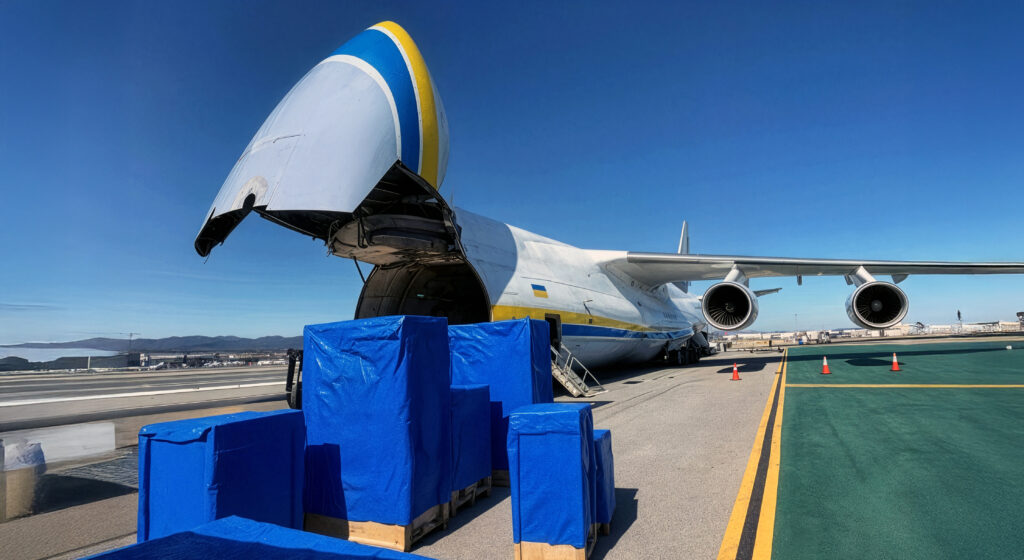
Packaging design doesn’t always reflect the physical constraints of transit. Aircraft doors, pallet footprints, and container dimensions impose limits that can significantly impact both cost and feasibility. A standard crate shape may be easy to build, but it’s not always the most efficient to ship—especially when you’re trying to maximize usable space and avoid paying for “air.”
Ocean freight can be significantly less expensive than air, but it introduces its own requirements. Standard containers are cost-effective because they’re standardized, but many industries still face crates that are too tall or too wide for standard containers. Nonstandard container solutions exist, but they can introduce tradeoffs in exposure and handling that high-value equipment owners may not be comfortable with.
Designing packaging with dimensional and environmental realities in mind reduces wasted space while keeping protection intact—because mode selection and packaging design work together to shape risk, environmental exposure, lead time, and customer confidence.
The solution: integrated engineering + logistics under one roof
This is where TransPak’s approach stands out. When engineering and logistics operate as one team, customers get smarter outcomes:
- Transit constraints can be considered at the beginning of the crate design process.
- Packaging can be optimized to protect against threats in transit without adding unnecessary volume.
- Freight cost, mode flexibility, and handling requirements can be engineered into the solution—not discovered later.
- Reusable and returnable packaging systems can be engineered for both protection and minimal return volume, supporting long-term reuse without driving up freight costs.
- Total landed cost can drop, even if the crate design itself becomes more sophisticated.
What this means for customers
Engineering with logistics in mind helps eliminate the surprises that slow shipments down and inflate budgets:
- Fewer last-minute rebookings
- Lower freight costs through smarter volume and mode planning
- More predictable transit and delivery timelines
- Better protection tuned to real-world transport conditions
- One coordinated strategy across packaging, crating, and freight execution
The takeaway
The best results happen when design and transit planning are aligned from day one.
That’s the power of TransPak’s integrated approach: protecting what matters while making global shipments more efficient, scalable, and cost-effective.
Talk to us about your freight, and we’ll redesign your crate.